CWD Surveillance Map
The Baiting and Winter Feeding Ban was removed in 2023. In a five year period only the one deer was found with CWD.
DNR Predator Prey Project Information

Map of the Upper Peninsula CWD Surveillance Area

History on the Michigan Surveillance and Response Plan for Chronic Wasting Disease (CWD).
The first Michigan Surveillance and Response Plans for CWD were issued On August 26, 2002 and were very general due to the lack of scientific research on CWD at that time. CWD was first observed in 1967 and not diagnosed until 1977 at a Colorado Research facility.
Wisconsin tested 1092 Deer from 1999 – 2001 and found only three positive CWD Deer. From 1999 to 2018 the State of Wisconsin has tested 226,833 Deer with 5,243 Deer being CWD positive. In 2018 alone Wisconsin tested 17,064 deer with 1057 being positive for CWD. Their Southern Farmland Zone accounted for 1036 of the 1057 animals! This area is estimated to have over 100 deer per square mile.
Following CWD in other states and how the states were handling it for years U.P. Whitetails Association Inc. In 2011 at a NRC meeting in Iron Mountain asked the Natural Resource Commission to update the Michigan Surveillance and Response Plan. The presentation included different points that could be addressed with a new plan and The Natural Resource Commission was asked not to follow Wisconsin’s plan of trying to kill them all (deer) with semi –loads of deer going to waste and spend over $37 million dollars doing it! We need a better plan! Commissioners; Frank Wheatlake and John Madigan, along with Russ Mason of the DNR agreed and with other support and research the plan was Revised and published July 18th 2012. The first positive CWD in the Lower Peninsula was found in 2015.
With the Revised plan in place and CWD being found in the Lower Peninsula a UP CWD Task Force was formed to work as Partners to come up with a plan just in case CWD was found in the Upper Peninsula. The first positive CWD deer was found in Dickinson County in October of 2018. Under the old plan all baiting and feeding in the entire Upper Peninsula would have been ban. Working together the MDNR and the UP CWD Task Force used the past knowledge of the Upper Peninsula winter kill and the migration studies over the years as reference and agreed on a ten mile buffer zone from the CWD positive Deer location and the townships touching that circle. The first UP plan draft using the Lower Peninsula CWD Plan that was already in place as a guide asked for touching counties. After some discussion the MDNR agreed with the UP CWD Task Force that our counties are much larger and the winter kill in the Upper Peninsula can account for the loss of thousands of animals. The MDNR would agree to use townships to try and allow feeding in the high snow zones of the Upper Peninsula. The MDNR is also very concerned with the winter kill in the medium to high snow zones.
The Core CWD Surveillance Area - Due to the need for road or river boundaries - starting at the junction of US 2 and 69 near Bark River, using all of Highway 69 to Highway 95 junction, South on HWY 95 to Iron Mountain and using the Menominee River going South as a boundary to Road G18 East to Highway 41 North , up to US 2 East, back to the junction of Highway 69.
Future meeting discussions for the UP CWD Task Force will include; Baiting and feeding, doe permits and antler point restrictions to name a few.
The Natural Resource Commission timeline in May every year – they will be given information regarding proposed changes to deer management units, deer quotas and regulations from the MDNR. In June every year - more updated information on the May information given to the NRC by the MDNR and Public Input. You do not have to wait until June to give your input! July every year - The NRC will take Action on possible changes.
For input by email contact: Cheryl Nelson NRC executive Assistant
For input by mail:
Department of Natural Resources
Executive Division
Attention: NRC
P.O. Box 30028
Fax 517-335-4242
Lansing Michigan 48909
Be sure to include a return address and sign you letter to be recorded.
Map of the recorded deer movements from the Trap,Tag and release Programs in the 1990's.


 The projects listed are that of all the organizations, some are done in each county and others are a joint effort by the organizations. (Education is a major concern and is supported by each organization in their local counties.)
 Sponsor of educational meetings between the Department of Natural Resources and the sportsmen as well as other seminars to help educate the general public, Cost share programs for Wildlife food plot openings and winter-feeding programs (if needed), billboard advertisement - Let'em GO - Let'em Grow for volunteer deer management, just to mention a few.

 For some years now different articles have been published on how far a deer will travel. Most of those articles were written about southern deer. Let me define that for you; a southern deer area to anyone from Upper Michigan means an area in winter that does not have three-six feet of snow!
 articles from in Deer and Deer Hunting, and other major magazines. One of the best deer specialists in the world! We worked side by side with John at Cusino as well as receiving John's expertise and knowledge on how to make the traps and handle the deer. John's technician at the center and the man who gave the actual hands on training of how to handle live deer out in the field was Dan DeLisle. Dan at present is the President of the Michigan United Conservation Clubs with over 500 member clubs. The local DNR technician Frank Short, U.P. Whitetails Association members Don Seymour and Pete Jandro were the main crew chiefs and schedule keepers also played a major roll in this ongoing project. Our volunteer members who worked with the deer-trapping projects over the years would number in the hundreds and saved the DNR an estimated $20,000.00 per year in labor costs alone. This savings enabled the DNR to do a project of this size that funding would not have been available for otherwise. This deer project could only be done in the winter after the migration from deep snow country had moved south to their winter yarding areas.
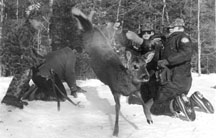
 As the sun is coming up and the frost is heavy on the trees we are driving to our trap sites every morning during the project. The snow under the tires of the truck is making a loud crunching noise, which means it is very cold and the deer were moving during the night to stay warm. As we get close to the first trap we can see the doors are down! Walking toward the trap the crunching sound from the snow is now under foot. Kneeling down in front of the trap we slowly rise to door about an inch or two and look into the trap. A large doe is lying there looking back. Using a smaller transfer box and a side door with a little sunlight at the end, we transfer her into the smaller transfer box (which she walks into). Now the work begins!
 You may be thinking four or five men on one poor little deer - poor deer. Bull! Poor workers, you have no idea the power of these animals. Our people are very well trained, in fact some of the best in the country we have been told by John Ozoga and we have all we can do to tag some of these larger animals. When ear tagging; the animal is only on the snow for a few minutes and released. When radio collaring the animals as we have done with Michigan State University on a three year study, the animals are on the snow about five to eight minutes and released. The animals are not hurt; in fact one year our Schoolcraft County Organization trapped the same animal fourteen times! He had good food, was warm, and knew he would be released. Not so dumb are they! Please do not try this at home. You could hurt or kill the animal or you if not trained in the proper manner.
 Since 1955, 2154 deer have been individually marked in Michigan. A total of 347 deer were marked using self-attaching deer collars during the 1955-1988 periods. Colored ear-tags have been used to mark 1807 additional deer since 1989. These marking efforts have yielded 1706 observations of tagged deer that are appropriate for determining the spatial distribution of tagged deer. Reports of another 56 deer may be used for demographic analysis but do not have adequate information for determining where the animals were observed.